Are External Cues Really Better Than Internal Cues in Yoga?
You may have heard that external cues are more effective than internal cues for teaching movement. But the research is more nuanced than this simple takeaway suggests – and when it comes to yoga, the picture becomes even more interesting.
This blog post was first sent to Jenni’s email list as an email newsletter. Sign up for the JRY email newsletter here!
If you’ve spent much time in the movement science, strength training, or fitness worlds, you may have heard this advice:
“External cues are better than internal cues.”
This idea comes from a large body of research on something called attentional focus – essentially, where we direct our attention while we move. Researchers have studied how different attentional strategies affect outcomes like athletic performance, coordination, balance, force production, movement efficiency, and motor learning.
And for years, a common takeaway from this research has been that an external focus tends to outperform an internal one.
But as is so often the case when we take a nuanced area of research and distill it into a simple rule, the full story is more complicated.
And when we try to apply this research to yoga, I think things get even more interesting!
First, what are internal and external cues?
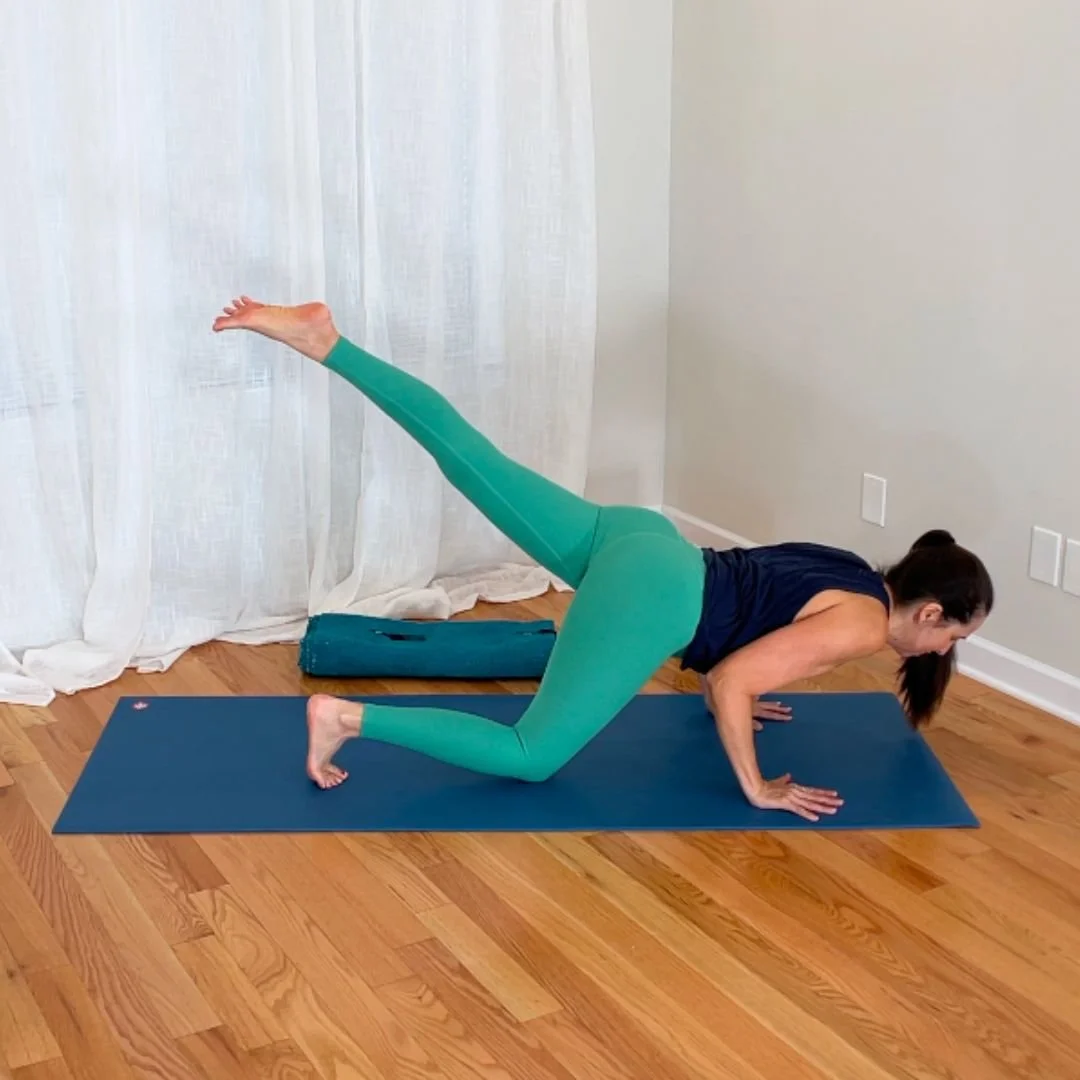
An internal focus directs attention toward the body itself – body parts, muscles, body position, or movement mechanics.
An external focus directs attention outside the body – toward the effect of a movement, the environment, an object, or our interaction with the space around us.
For example, imagine you're jumping.
An internal cue might be:
“Straighten your knees.”
An external cue might be:
“Push the floor away.”
You're performing essentially the same movement task, but your attention is directed somewhere different. In the first example, you're thinking about what your body is doing. In the second, you're thinking about your interaction with the environment.
We can apply this same distinction to yoga.
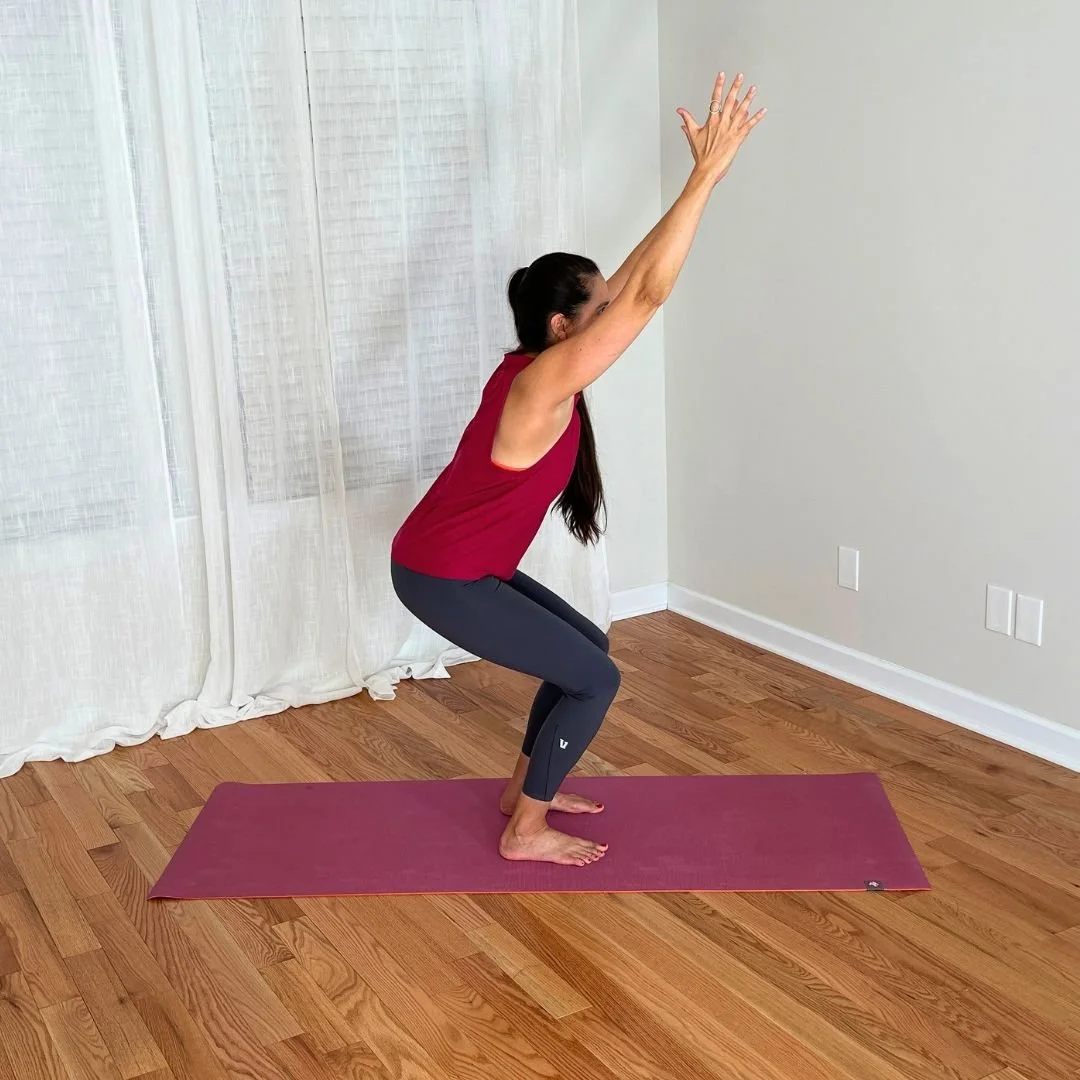
Imagine you're in chair pose and you're ready to stand up into tadasana.
An internal cue would be:
“Straighten your knees to stand up.”
An external cue would be:
“Press the floor away to stand up.”
Again, same basic movement – but a different attentional focus.
Why Are External Cues Often Considered Better?
Historically, a lot of attentional focus research found advantages to an external focus for outcomes like jump height and distance, sprint speed, force production, accuracy, coordination, and movement efficiency. Meanwhile, an internal focus has been associated with increased conscious awareness of movement and increased muscle activation or neural drive.
One proposed explanation for the external focus advantage is that directing attention toward the effects of a movement may allow the nervous system to organize that movement more automatically. In contrast, focusing closely on the mechanics of our own bodies may sometimes interfere with this automatic organization by encouraging too much conscious control.
And this might seem intuitive if you really think about it!
If you’re asked to jump as high as possible, “Push the floor away!” is simple and task-oriented.
Compare that with something like:
“Rapidly extend your hips and knees.”
That second instruction gives your conscious mind more to manage during a movement that your nervous system already knows how to coordinate.
So it makes sense that external cueing became influential in athletic coaching, strength and conditioning, fitness, and rehabilitation.
But out of these insights, an oversimplified message eventually emerged that isn’t so helpful:
External cues = good. Internal cues = bad.
And this where I think we could use to pause and look at the nuance involved in this topic!
What Does the Research on Internal vs. External Cueing Actually Say?
More recent discussions of attentional focus have questioned whether the external focus advantage is as universal or as large as it was sometimes presented.
For example, a 2024 paper by McKay and colleagues re-analyzed previous meta-analytic findings while examining the possible effects of publication bias. After correcting for potential bias, the estimated benefits of external focus became considerably smaller and more uncertain. The authors concluded that the existing evidence doesn't allow us to confidently determine whether an external focus provides meaningful benefits to motor learning and performance.
And a more recent 2026 network meta-analysis of 87 studies further complicated the picture. When attentional focus strategies were classified in more detail and factors such as participants' expertise were considered, the results varied rather than pointing toward one universally superior attentional strategy.
In other words, the question probably isn't:
“Which type of cue is better?”
It may be:
“Better for whom, for what task, and for what outcome?”
The person's experience level may matter. The complexity of the movement may matter. The specific outcome we're interested in may matter.
And other characteristics of the cues themselves may matter beyond whether they’re internal or external!
For example, consider these two cues:
“Extend your knees and hips rapidly.”
and:
“Push the floor away.”
The second cue isn't solely more external. It's also arguably simpler and more intuitive.
So if someone happens to perform better with the second cue, is that because their attention was externally focused? Or is it because they were given a clearer, simpler movement instruction? (Or some combination of both?)
The research doesn’t provide an easy answer to this.
And then there’s the fact that yoga is a different movement context from the athletic and performance settings where much of this research has been conducted!
What Does Attentional Focus Research Mean for Yoga?
This is where I think applying attentional focus research becomes especially interesting.
Attentional focus research sits at the intersection of sport psychology, motor control, motor learning, and movement science, and much of it has examined sports and athletic performance.
In these contexts, the outcomes of interest are relatively straightforward to measure:
-How high did you jump?
-How fast did you sprint?
-Did the basketball go through the hoop?
-How accurately did you throw the dart?
-How much force did you produce?
But in a yoga practice, our “outcomes” aren’t so straightforward and easy to measure!
Sometimes we do have a fairly clear performance goal. We might be trying to balance in tree pose, build strength in a particular movement, learn an arm balance, or coordinate a challenging transition.
But many other times in our yoga practice, the goals are much less concrete. We might be aiming to notice sensation, explore a movement, become more aware of our body, connect movement with breath, observe how one side feels compared with the other, or simply appreciate and be present with the experience of moving.
These are meaningful outcomes, but they're much harder to measure than something like jump height or throwing accuracy. This is why attention focus literature doesn’t map well onto yoga: awareness, sensation, breath connection, exploration, mindfulness, and self-inquiry aren’t easy to measure and study in a research context.
Yoga is an Inherently Internal Practice, and Its Cues Will Reflect This
Compared with sports and athletics – which attention focus research often studies – yoga is in many ways, an inherently internally-focused practice.
We pay attention to our bodies. We notice sensations. We observe our breathing. We explore how movements feel.
It’s therefore almost impossible to practice yoga without involving internal cues!
In fact, if we took the oversimplified message “external cues are better” and applied it to yoga, we'd potentially eliminate some of the very goals we're interested in cultivating on the yoga mat.
This is why I believe that both internal and external cues have important roles to play in yoga.
For example, if I'm teaching a strength-focused movement in yoga and I want to support students in moving efficiently through a familiar sequence, I might cue, “Push the floor away” because it’s wonderfully simple and effective.
But if instead I’m leading students through an exploration of how a yoga pose feels, I might say, “Notice where you feel the effort”, or “What happens to the sensation in your hamstrings if you bend your knee a little more?”
Those are internally oriented cues… and that's the whole point! I'm intentionally directing attention toward bodily sensation because body awareness is the goal of that particular experience.
So depending on our goal in the moment, both internal and external cues can have their place in a yoga context.
How I Approach Internal and External Cueing as a Yoga Teacher
In addition, I don’t think it’s helpful to apply the attentional focus framework to every sentence a yoga teacher says.
Attentional focus research is primarily concerned with movement-directed cues. But movement direction is only one aspect of yoga cueing!
We might also use sensation-oriented cues, observational or awareness cues, exploratory cues, and breath-focused cues. My broader framework for yoga cueing includes all of these categories because our language can guide both movement and attention.
So if we boil all yoga cueing down to either “internal” or “external” cues, we’ll be missing a major portion of what yoga teaching actually involves!
In my yoga teaching, I tend to prioritize three things: simplicity, clarity, and efficiency.
Sometimes an external or environment-oriented cue happens to accomplish those goals perfectly.
For example:
“Push the floor away.”
may be clearer and simpler than:
“Spread your shoulder blades.”
Or:
“Rotate your chest toward the side wall.”
may be more immediately understandable than:
“Rotate your chest to the left.”
But my main goal here isn’t to use an external cue for the sake of it being external. My goal is to communicate clearly and simply and to direct someone's attention in a way that supports what we're actually doing.
Sometimes an external cue is exactly the right tool, and sometimes an internal cue is the best fit in the moment.
A better question for yoga teachers than “are external cues better?”
Rather than asking:
“Are external cues better than internal cues?”
I think a more useful question is:
“How can I direct my students' attention in a way that supports the goal of this particular movement experience?”
If the goal is performance, efficiency, or fluid movement, an external or big-picture cue may be useful.
If the goal is body awareness, sensation, exploration, or deliberately learning something about a movement, an internal focus may be exactly what we want.
And sometimes either one might work just fine.
That's why I think internal and external cues are best understood as tools, not rules. Neither is universally superior. Context matters.
This is also part of a bigger shift I encourage yoga teachers to make around cueing in general. Cueing isn't simply about finding the “perfect” instruction for each pose. It's how we guide movement and attention through language, and it can shape movement, sensation, exploration, awareness, pacing, breathing, and the overall experience we're creating for our students.
This gives us a much richer set of possibilities than simply asking whether a cue is internal or external!
Want to dive deeper into the science of yoga cueing?
Internal and external cueing is just one of the many topics I explore in my course Yoga Cueing Through a Movement Science Lens.
This 3.25-hour continuing education course brings together motor learning research, movement science, cueing philosophy, and practical teaching strategies to take a fresh look at how we guide movement and attention in yoga.
We explore internal vs. external cues, self-organization, cue density, accessible teaching language, movement vs. muscle-based cueing, and much more, with practical yoga examples throughout. The goal of this course isn't to give you another list of “good cues” and “bad cues,” but to help you develop a broader framework for making thoughtful, evidence-based cueing decisions in your own teaching.
References
McKay, Brad, et al. "Reporting bias, not external focus: A robust Bayesian meta-analysis and systematic review of the external focus of attention literature." Psychological Bulletin150.11 (2024): 1347.
Peng, Fan, et al. "Reevaluating Attentional Focus on Motor Performance According to Expertise: A Stratified Network Meta-Analysis." Psychology of Sport and Exercise (2026): 103215.
FAQ
What is the difference between internal and external cues?
Internal cues direct attention toward the body or its movements, while external cues direct attention toward the effect of the movement on the environment. For example, “Straighten your knees” is an internal cue, while “Push the floor away” is an external cue.
Are external cues better than internal cues?
Not necessarily. Although attentional focus research has often found advantages to external cues for certain performance and motor learning outcomes, more recent research suggests the picture is more nuanced. The effects of a cue can depend on the task, the outcome being measured, the individual, and other contextual factors.
Should yoga teachers use external cues instead of internal cues?
No. Internal and external cues can both be useful in yoga. Unlike many athletic settings, yoga doesn't always have a single performance goal. We may be interested in strength or balance, but we may also be cultivating body awareness, sensation, exploration, mindfulness, or breath awareness.
What are some examples of external cues in yoga?
Cues such as “Push the floor away,” “Reach toward the ceiling,” or “Rotate your chest toward the side wall” direct attention toward the environment or the effect of the movement rather than focusing exclusively on body mechanics.
How should yoga teachers decide which cues to use?
Rather than trying to make every cue internal or external, I think it's more useful to prioritize cues that are clear, simple, and meaningful for what you're trying to accomplish. Sometimes an external cue will fit that goal beautifully, and sometimes an internal cue will make more sense.
Related Post:
You Might Also Like…