Chronic Pain & Self-Efficacy: What Research on Protective Factors Can Teach Us
What factors might help people with chronic pain experience less disability and better physical function? A recent research review offers some interesting insights – including one finding that got me thinking about self-efficacy in yoga practice and teaching.
This article was originally shared in my email newsletter, where I send free, research-informed insights about yoga anatomy, biomechanics, and movement science every 1–2 weeks. Sign up here!
I came across a pain research article exploring protective factors associated with better physical function and less disability in people with chronic musculoskeletal pain, and I thought many of us in this community might find it interesting!
I especially like this article because it took a different approach than much of the chronic pain research we're used to seeing.
Here’s what I mean!
A Different Approach to Chronic Pain Research: Salutogenesis
Most research on chronic pain has traditionally focused on risk factors or deficits: What predicts worse outcomes? What contributes to pain, disability, or poor function?
In other words: what factors may negatively influence our pain/function/well-being?
This paper on chronic musculoskeletal pain instead takes a – are you ready for a new vocabulary word of the day? 😛 – salutogenic perspective.
Salutogenesis is an approach to healthcare that shifts the focus from what causes disease (pathogenesis) to what supports health and well-being instead. It’s a shift from negative factors to positive ones.
So rather than focusing primarily on what's going wrong, a salutogenic perspective asks:
What helps people do well despite adversity?
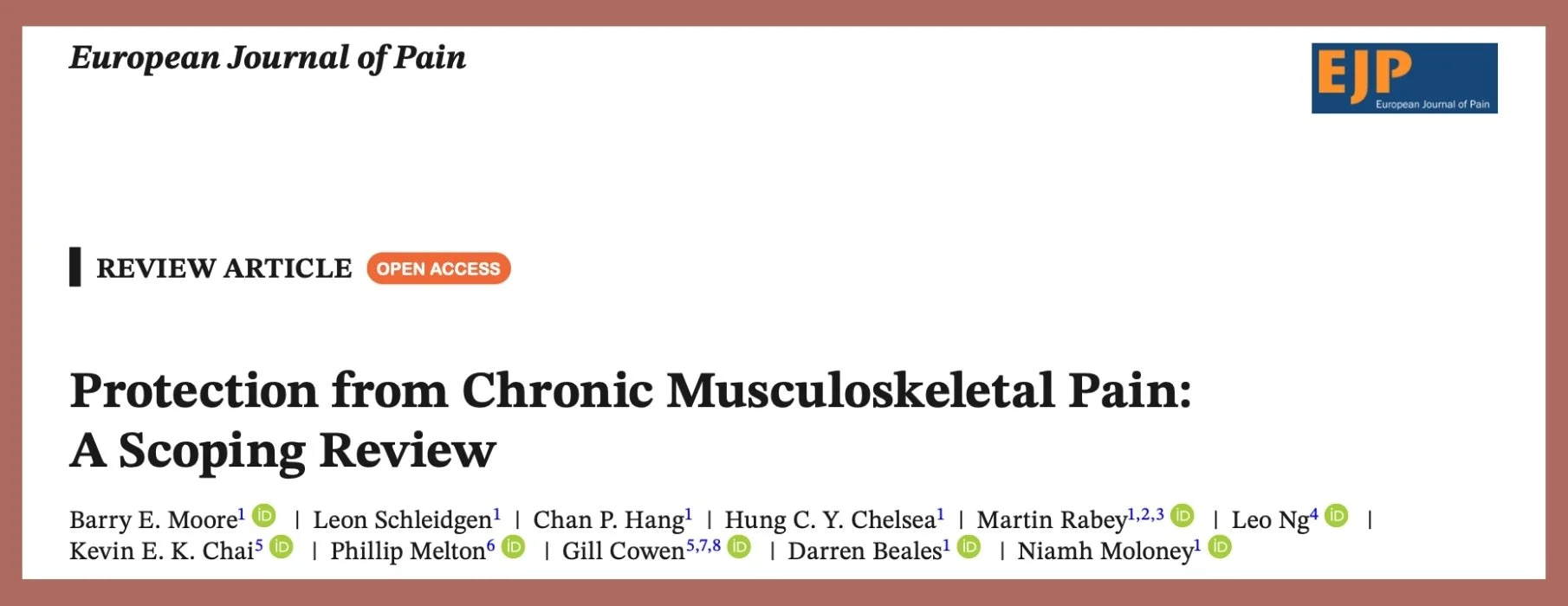
This research article – published in the European Journal of Pain in April 2026 – took this more positive, salutogenic approach.
The researchers were interested in identifying protective factors associated with less disability or higher function in adults with chronic musculoskeletal pain (Moore et al., 2026).
They used a scoping review to investigate this question:
What Does “Protective” Mean in Chronic Pain Research?
One important clarification: this review was not looking at factors that protect people from developing chronic pain in the first place.
Instead, it focused on people who already had chronic musculoskeletal pain and asked:
Among people living with chronic pain, what factors are associated with lower disability, and better physical function?
So in this context, "protective" means protective against poorer outcomes, not necessarily protective against pain itself. ☝️
Which Factors Were Associated With Better Chronic Pain Outcomes?
The authors reviewed a wide range of potential protective factors, including:
• Psychological factors such as self-efficacy, resilience, optimism, and pain acceptance
• Lifestyle factors such as sleep, diet, physical activity and aerobic exercise
• Social factors such as social support
• Physical factors such as strength, range of motion, and exercise capacity
Self-Efficacy and Chronic Pain: What Did the Research Find?
Among all of these possible factors, self-efficacy had the largest and most consistent body of evidence associating it with lower disability and better physical function in people with chronic musculoskeletal pain.
What is Self-Efficacy?
Self-efficacy is your belief in your ability to successfully carry out a task or cope with a challenge. It's not simply confidence or optimism in general. It's more task-specific than that:
"I believe I can find a way through this."
"I believe I can learn this movement."
"I believe I can adapt when things don't go exactly as planned."
So self-efficacy – a psychological factor (!) – was the most consistent factor that may be protective for people experiencing pain.
Isn’t that so interesting?
What Could Self-Efficacy Mean for Yoga Practice and Teaching?
This research on self-efficacy and chronic pain resonates with something I think about often when I teach yoga classes, and in the continuing education courses I offer.
Ultimately, I strive for our yoga/movement practice to offer opportunities to experience ourselves as capable.
I think it's valuable to teach in a way that gives students agency over their own bodies so they feel empowered to make informed decisions about their practice. My hope is that this kind of learning environment supports self-efficacy by offering opportunities for students to experience an appropriate sense of "I can" that's relative to their individual bodies, goals, and abilities.
It's not "I can do everything." It's "I can find a way."
What might this actually look like in practice?
Sometimes this looks like discovering a variation of a pose that works well for your body. Sometimes it's learning a movement that once seemed confusing. Sometimes it's realizing you're stronger than you gave yourself credit for. Sometimes it's simply recognizing that you can adapt.
Rather than teaching yoga in a way that suggests there are many "wrong" ways to move, or that our bodies are fragile and need constant protection, my goal is to help cultivate the experience of our bodies as adaptable, resilient, and capable.
That doesn't mean we ignore pain, limitations, or challenges. Of course not! It just means that we also pay attention to our strengths and the abilities we already have within us.
Now while self-efficacy emerged as the factor with the largest and most consistent body of evidence in this new study, it certainly wasn't the only factor associated with positive outcomes…
What Other Factors Were Associated With Better Outcomes?
The review article also highlighted lifestyle and physical factors such as physical activity, aerobic exercise, strength, range of motion, and exercise capacity.
These factors were also associated with positive outcomes. ✅
And the authors note that many of these physical factors are modifiable through exercise and movement activities (like what we do here in my online yoga/strength studio!), and they emphasized that exercise remains a consistently recommended component of chronic pain management. 👏
What Can We Take Away From This Research?
I thought this article provided a refreshing perspective on pain and associated outcomes. Rather than focusing solely on "What's wrong?" this research asks, “What’s right?” and "What strengths can we build on?"
That feels like a worthwhile question, both in research and in yoga/movement practice!
Frequently Asked Questions About Self-Efficacy, Yoga, and Chronic Pain
What is self-efficacy in chronic pain?
Self-efficacy is a person's belief in their ability to carry out a task or cope with a challenge. In the chronic pain research discussed here, greater self-efficacy was consistently associated with lower disability and better physical function.
Does self-efficacy reduce chronic pain?
Not necessarily. This research looked at factors associated with better function and lower disability among people who already had chronic musculoskeletal pain. An association with better outcomes doesn't necessarily mean that self-efficacy reduces pain itself or causes those better outcomes.
What factors may be protective for people with chronic pain?
The review examined psychological, lifestyle, social, and physical factors. Self-efficacy had the largest and most consistent body of evidence, while factors including physical activity, aerobic exercise, strength, range of motion, exercise capacity, resilience, optimism, pain acceptance, and social support were also investigated.
How might yoga support self-efficacy?
Yoga and movement practice can offer opportunities to experience ourselves as capable – for example, finding a pose variation that works, learning a new movement, building strength, or discovering that we can adapt when something doesn't go as planned. How yoga is taught may matter here, too: giving students meaningful choices and agency can create opportunities to practice that sense of “I can find a way.”
Is exercise recommended for chronic pain?
Exercise is commonly recommended as one component of chronic pain management, although there isn't one type or dose of exercise that's appropriate for everyone. Individual circumstances, preferences, abilities, and health considerations matter.
I especially like questions #1 and #2 for this article because they guard against people reading “self-efficacy is protective” and walking away with the much stronger causal claim that increasing self-efficacy reduces pain. That's exactly the kind of nuance worth preserving.
Reference:
Moore, B. E., Schleidgen, L., Hang, C. P., Chelsea, H. C., Rabey, M., Ng, L., ... & Moloney, N. (2026). Protection from Chronic Musculoskeletal Pain: A Scoping Review. European Journal of Pain, 30(4), e70273.
You Might Also Like…