What You Feel in a Stretch: New Research
This blog post was first sent to Jenni’s email list as an email newsletter. Sign up for the JRY email newsletter here!
A new study (Barrett et al., 2026) examined the difference between internal stretch sensation and an external tester’s perception of muscle tension.
Hey yoga geeks! 🤓
I came across a brand-new study on a fascinating aspect of stretching that feels very relevant for us as a yoga community – and honestly, especially relevant for anyone who teaches and gives hands-on adjustments. ‼️
This study looked at the difference between what we feel in a stretch in our own body internally vs. what an outside person feels if they’re pushing us into a stretch externally.
So: internal vs. external perceptions of stretch. Isn’t that such a great research topic??
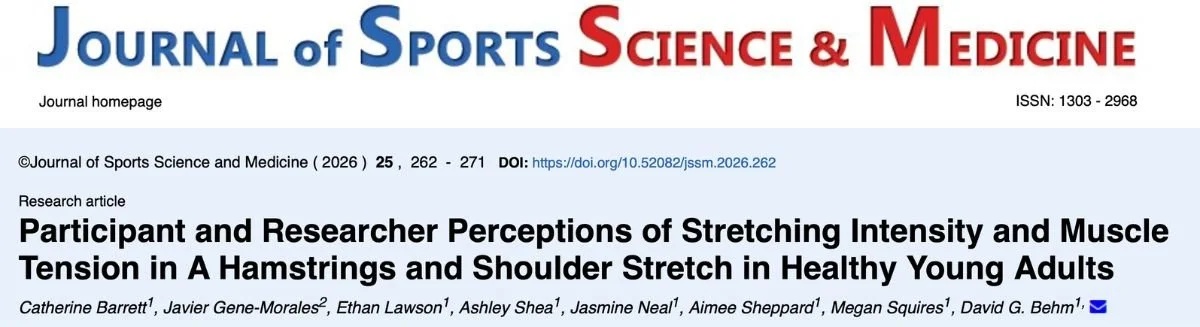
The study is called “Participant and Researcher Perceptions of Stretching Intensity and Muscle Tension in a Hamstrings and Shoulder Stretch in Healthy Young Adults” (Barrett et al., 2026).
Before we look at what the researchers did, I want to take a quick step back and make sure we’re all on the same page about something important:
How flexibility gains actually happen.
Because a lot of us were taught this idea that stretching makes muscles physically longer. Like we’re pulling them out like taffy, and they get “lax” and “loose” inside of us.
And that’s not how it works! ☝️There’s no evidence that stretching makes our tissues long, loose, and lax. (Phew heheh!)
Instead, there are two main explanations in the research for why flexibility improves:
Mechanical changes in the muscle – loosely meaning that the muscle resists less in the stretch (less force is required to lengthen it to any given point).
Increased stretch tolerance – your nervous system allows you to go further by outputting sensations of discomfort later in the range.
The first explanation about the muscle resisting less is referred to as the “mechanical theory” – because it describes mechanical changes that take place within the muscle (or muscle-tendon unit) itself. As we increase flexibility, our muscles’ internal “tightness” doesn’t start resisting until later in the range of motion.
The second explanation about stretch tolerance is referred to as the “sensory theory” – because it has to do with your nervous system changing the sensations you feel in the stretch. As we increase flexibility, we perceive a feeling of tightness later in the range of motion.
So one explanation has to do with physical properties of the muscle that can be objectively measured with specialized equipment (e.g. a dynamometer in a lab), and the other has to do with our sensations in the stretch – which can only be subjectively measured by the person in the stretch reporting how they feel.
In reality, flexibility gains are often the result of some combination of both mechanical and sensory changes – it’s not necessarily just one or the other. But those are the two main explanations for how flexibility gains happen!
Now, onto the topic at hand: this fascinating new stretching research!
So what did this new study look at?
This is the cool part. The researchers asked: what’s the relationship between internal and external perceptions of stretch intensity?
Because when stretching is given as an intervention, it’s generally prescribed in terms of intensity – “Stretch to a 5 out of 10”, or “Stretch to an 8 out of 10”, etc.
And there are two ways in which this intensity level is generally assessed:
The person stretching says: “Okay, that’s my max stretch sensation.”
The coach/therapist/yoga teacher feels: “Okay, I feel strong tension here.”
But do those two endpoints actually match? Or are they different?
That’s what this study examined!
What they did
They tested 18 young adults in two passive stretches:
hamstrings (hip flexion)
shoulder extension
For each stretch, they measured range of motion in two ways:
Participant perception (internal – sensory)
The person stretching themselves said:
this is my “first stretch sensation”
this is my “maximum tolerable stretch”
Researcher perception (external – mechanical)
The researcher passively moved the limb into the stretch and stopped when they felt:
“initial tension”
“maximum tension”
So basically: Internal sensation vs external hand-feel.

What they found (this is the interesting part!)
A few big takeaways:
1. Both methods were consistent on their own
If you always use participant sensation, you get consistent results.
If you always use researcher “tension feel,” you also get consistent results.
So both are reliable methods.
2. But they did NOT match each other
They weren’t interchangeable.
Especially for the hamstrings:
The researcher’s “maximum tension” usually happened at more range of motion than the participant’s “maximum tolerable stretch.”
In plain English:
👉 The stretcher tended to push farther than the person would choose themselves.
3. Experience mattered a lot
This difference was bigger in people who were:
sedentary
new to stretching
less trained
And smaller in:
people who stretch regularly
athletes
So beginners and less experienced people were the least likely to match the external researcher’s perception.
Which is… very interesting if you teach yoga!
What does this actually mean?

Here’s how I interpret it.
The person stretching themselves is stopping based on:
sensation
discomfort
tolerance
The external person stretching someone else is stopping based on:
tissue resistance
mechanical “end feel”
Those are not the same signals.
So just because a teacher might feel “there’s still room” doesn’t mean the student feels the same way.
There might technically be more mechanical range available… but the student may already feel maxed out from a sensation or tolerance standpoint.
Importantly, this study does not suggest that one of these endpoints is the “correct” one. It just shows that they’re different.
Why this feels so relevant for yoga teachers
Most yoga is self-directed stretching. So this supports something we already lean toward:
👉 Internal sensation is generally the most relevant guide.
In yoga, we’re not chasing some externally determined “end range.” Instead, we’re positioning our body based on sensation and what we feel inside.
But this study is especially relevant for hands-on assists by yoga teachers. Because it suggests:
Your hands feeling “not much tension yet” ≠ your student feeling “comfortable to go farther”.
And interestingly, this difference was larger in participants with less stretching experience. They tended to stop earlier based on sensation, even when the external tester could still move the limb farther, suggesting that internal and external perceptions of stretch intensity were less well aligned in newer stretchers.
This is a really nice reminder that:
lighter
invitational
student-led adjustments
probably make a lot of sense.
My favorite takeaway
What’s interesting here isn’t that experienced stretchers go farther – we already know that stretch tolerance adapts with training.
What’s new is that this study directly compared internal sensation with an external tester’s perception of tension, and showed that those two don’t always line up.
This might already feel intuitive to many of us as teachers, but it’s nice to see some actual data behind it. Especially with newer yoga students, a teacher’s sense of “there’s still room” may not match what the student feels at all.

A quick caveat about injury – just to head off any panic 😅
Reading a study like this, I know it might be easy to jump to a conclusion like:
“If an external person tends to move someone farther than they’d go themselves… then hands-on adjustments in yoga must be dangerous.”
So I just want to point out that this research does not actually suggest this! ☝️
First of all, this study didn’t look at injury risk at all.
The researchers weren’t testing whether one endpoint was “safer” than the other. They were simply comparing perceptions – internal sensation vs external “tension” feel. So we can’t draw any conclusions about injury from this research.
Second, while it often makes sense to let sensation guide our stretching, that sensation isn’t a hard safety boundary. Most of us have more mechanical range available than our nervous system actually allows us to explore. Our brains tend to be conservative and protective. This general physiological pattern is reflected in this study as well.
(We also see similar findings in other areas of research – for example, people often demonstrate more passive range of motion under anesthesia, when the nervous system isn’t guarding or responding to sensation.)
And interestingly, in this study the external stretcher generally did move participants a bit farther than they would have chosen themselves… and there were no injuries reported. If a little extra passive range were inherently harmful, we’d expect to see problems in a setup like this – but we don’t.
Third, these were slow, low-load, static stretches. That’s not typically how tissue injuries happen. Injuries are much more often associated with higher loads, faster forces, or abrupt movements – like falls, cutting, or explosive efforts. Gentle, controlled stretching just isn’t a very threatening stimulus for most healthy tissue.
And finally, studies like this go through ethics review. Research that’s considered inherently unsafe or likely to injure participants simply doesn’t get approved.
All of this lines up with what we already know from stretching research and pain science: our nervous system often says “that’s enough” well before we’ve reached any true structural limit.
So yes – letting sensation guide us is wise, and very yoga-aligned. But we probably don’t need to fear that exploring a little more range in a slow, controlled stretch is automatically dangerous. In this context, a stronger stretch sensation is most often just a sensory response, not a sign of injury.
So to me, this stretching study feels less like a warning and more like a helpful reminder.
Our bodies aren’t fragile, and our sensations aren’t perfect measurements of our true limits. They’re just information.
As yoga practitioners and teachers, that probably means continuing to do what we already value: moving with awareness, communicating clearly, and letting each person decide what feels right in their own body.
By the way, if you’re a yoga geek like I am who finds stretching science like this inherently fascinating 🤓, you might enjoy my stretching science CE courses on my website!
There are currently three of them:
-Stretching Science 101 – 2 hours
-Stretching Science 101 (2.0) – 3.5 hours
-Isometric Stretching: Activation at End Range. – 3 hours
You can take these coures any time, and they all count for CE hours with Yoga Alliance.
Ready to dive in? Join my Continuing Education membership – it starts with a 7-day free trial, and you can cancel any time!
I’ll see you there for more stretching brain gains! 🧠
You Might Also Like…